Robert Dudley: Elizabeth I's Enduring Favourite
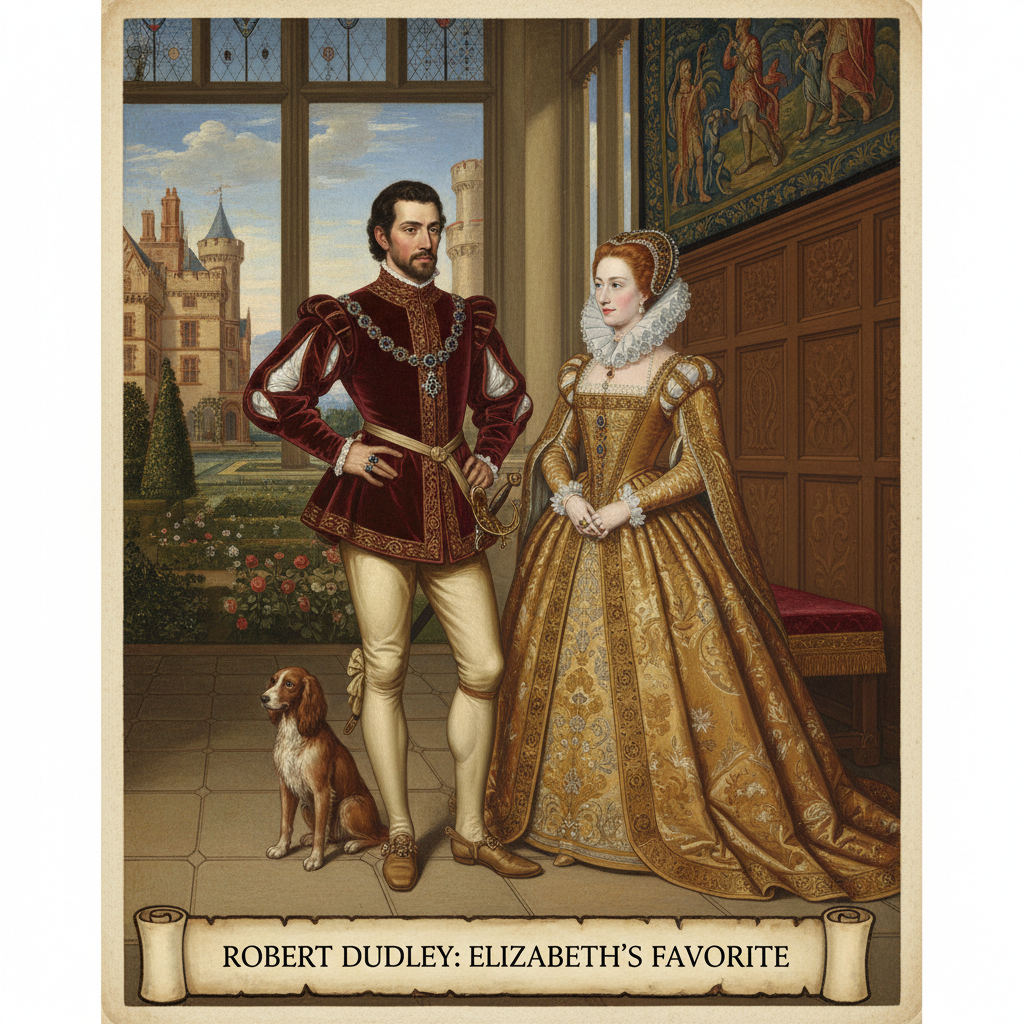
In the glittering, treacherous court of Queen Elizabeth I, one man stood out above all others: Robert Dudley, Earl of Leicester. Their relationship, a complex tapestry woven with threads of childhood friendship, passionate love, political ambition, and public scandal, captivated their contemporaries and continues to fascinate historians today. He was not merely a courtier; he was the Queen's 'Sweet Robin', a figure whose influence and proximity to the throne were unmatched, and whose story is inextricably linked with Elizabeth's own.
The Childhood Sweethearts: A Bond Forged in Adversity
Robert Dudley's journey to becoming Elizabeth's favourite began not in the splendour of the royal court, but in the shared confinement of their youth. Born in 1532, the fifth son of John Dudley, Duke of Northumberland, Robert grew up alongside the young Princess Elizabeth. Their early years were marked by the turbulent religious and political shifts of the Tudor era. Both experienced the harrowing fall from grace that came with the execution of Robert's father for his role in placing Lady Jane Grey on the throne, an act that also saw Elizabeth herself imprisoned in the Tower of London.
This shared experience of vulnerability and uncertainty forged an unbreakable bond between them. When Elizabeth ascended to the throne in 1558, Robert was immediately elevated. He was appointed Master of the Horse, a position of great intimacy and trust, granting him constant access to the Queen. This swift rise, coupled with his undeniable charm and striking good looks, quickly made him a dominant figure at court.
"He was a very handsome and well-made gentleman, and had a very good presence. He was also a good horseman, and a good jouster, and a good dancer, and had a good wit, and was very courteous and affable." – William Camden, Annales Rerum Gestarum Angliae et Hiberniae Regnante Elizabetha
Did You Know?
Robert Dudley was known for his extravagant spending, particularly on clothing and jewels. He once ordered a doublet embroidered with 1000 pearls and another with 2000 gold spangles, reflecting his desire to match the Queen's own lavish style and impress her.
The Scandal of Amy Robsart: A Shadow Over Their Love
The intensity of Elizabeth and Robert's relationship was undeniable, leading many to believe, and fear, that they would marry. However, there was one significant obstacle: Robert was already married to Amy Robsart. Their union, contracted in 1550, was a conventional aristocratic match, but it became a source of immense complication and tragedy.
In September 1560, Amy Robsart was found dead at the bottom of a staircase at Cumnor Place, a house near Oxford where she had been staying. The official verdict was an accidental fall, but rumours of foul play immediately erupted. Many suspected Robert Dudley, believing he had murdered his wife to clear the path to the Queen's hand. The scandal was immense, threatening to tarnish both Dudley's reputation and Elizabeth's own.
Despite a coroner's inquest ruling of accidental death, the whispers never truly died down. The incident cast a long, dark shadow over their relationship, making a marriage between them politically impossible. Elizabeth, ever pragmatic, knew that marrying a man widely suspected of murdering his wife would be disastrous for her nascent reign. This event, more than any other, perhaps defined the limits of their love and ambition.
Ambition, Influence, and Enduring Devotion
Despite the Amy Robsart scandal, Robert Dudley's position as Elizabeth's favourite remained largely unchallenged. He became Earl of Leicester in 1564, a title that reflected his elevated status. He was a Privy Councillor, a Knight of the Garter, and held numerous other significant offices. His influence permeated every aspect of court life and government.
Dudley was a patron of the arts, a keen supporter of Puritanism, and a military man. He led English forces in the Netherlands during the Dutch Revolt (1585-1587), a campaign that, while not entirely successful, demonstrated his commitment to Elizabeth's foreign policy objectives. He was also instrumental in the preparations for the defence against the Spanish Armada in 1588, serving as Lieutenant General of the Army.
A Complex Legacy: Rivalries and Loyalties
Robert Dudley's prominence naturally bred jealousy and rivalry. He clashed frequently with William Cecil, Lord Burghley, Elizabeth's chief minister, whose more cautious and pragmatic approach often stood in stark contrast to Dudley's more adventurous and sometimes impulsive nature. These rivalries were not merely personal; they represented different factions and philosophies within the Elizabethan court.
Yet, through all the political machinations, the public scrutiny, and the passage of time, Dudley's devotion to Elizabeth never wavered. He was her confidant, her companion, and her most trusted friend. Their letters reveal a deep affection, often filled with playful nicknames and expressions of endearment. He was one of the few people who could speak frankly to the Queen, even when it meant disagreeing with her.
His second marriage, to Lettice Knollys (a cousin of the Queen), in 1578, was conducted in secret and infuriated Elizabeth, who felt betrayed. This episode highlights the possessive nature of their bond; Elizabeth expected an almost singular devotion from her 'Sweet Robin'. Despite her anger, Dudley's position, though temporarily strained, ultimately endured.
The End of an Era: Dudley's Lasting Impact
Robert Dudley's final act of service to Elizabeth came during the Spanish Armada crisis. Despite his failing health, he rallied to the Queen's side, overseeing the land forces at Tilbury. It was a poignant moment, a testament to their lifelong partnership in the face of England's greatest threat. Shortly after the defeat of the Armada, in September 1588, Dudley died. His last letter to Elizabeth, found amongst her private possessions after her own death, was marked by her as 'His last letter'.
The death of Robert Dudley was a profound personal loss for Elizabeth. He had been a constant presence in her life for over 40 years, a link to her youth and a steadfast companion through the trials of her reign. His passing marked the beginning of a more solitary period for the aging Queen.
Robert Dudley's life was a microcosm of the Elizabethan age itself: ambitious, dramatic, and often controversial. He was a man of power, passion, and privilege, but also one who lived under the constant, intense gaze of his Queen. His story is a powerful reminder that even monarchs, for all their power, are deeply human, capable of profound affection and enduring loyalty. To understand Elizabeth I, one must understand Robert Dudley, for he was truly her 'Enduring Favourite'.
TAGS
Discussion
No comments yet
Be the first to share your thoughts on this article!
You May Also Like
Continue exploring Tudor history with these related articles

Catherine Parr: The Survivor Queen and Royal Reformer
Catherine Parr, the sixth and final wife of Henry VIII, was a scholar, reformer, and political survivor. Discover how she navigated the treacherous Tudor court, escaped execution, and profoundly influenced the education of the future Elizabeth I and Edward VI.

Greenwich Palace: The Lost Cradle of Tudor Royalty
Discover the lost grandeur of Greenwich Palace (Placentia), the primary residence and crucial birthplace of the Tudor dynasty. This comprehensive article explores how Henry VII established the palace, the spectacular court life under Henry VIII, and its vital role as the birthplace of Henry VIII, Mary I, and Elizabeth I, before its eventual replacement by the Old Royal Naval College.

Edward VI: The Tragic Reign of the Boy King
Edward VI, the only son of Henry VIII and Jane Seymour, ascended the throne at age nine. His brief but transformative reign (1547–1553) saw the radical acceleration of the English Reformation, fundamentally shaping the religious identity of England despite his tragic early death.

Bosworth Field: How Henry VII Won the Crown and Began the Tudor Dynasty
Explore the dramatic Battle of Bosworth Field (1485), where Henry Tudor, the unlikely challenger, defeated Richard III, ending the Wars of the Roses and ushering in the powerful and enduring Tudor dynasty.